Visit Tongue Fu Talking®
There is a persistent misconception in schools that oracy is about performance. Clear voice. Confident delivery. Polished presentation.
That is part of it.
But it comes later.
Before students can present ideas, they have to form them. And that process is not silent. It is shaped through talk.
This is where oracy and metacognition meet.
Talk is not the outcome. It is the mechanism.
If we treat talk as something that happens at the end of learning, we miss its real power. Students do not simply think and then speak. In many cases, they think through speaking.
This is well supported in research. Dialogic approaches to teaching show that structured talk improves reasoning, understanding and attainment, particularly when it is deliberately taught rather than left to chance (Mercer and Littleton, 2007; Alexander, 2020).
Metacognition plays a similar role. It is not an add-on. It is the process by which students plan, monitor and evaluate their thinking.
Put simply:
- Oracy gives students the means to express thinking
- Metacognition gives them the control to shape it
When the two are combined, thinking becomes visible, shared and refined.
The problem: talk without thinking
In some classrooms, students are encouraged to talk, but not taught how to think within that talk.
This leads to familiar patterns:
- Ideas are exchanged but not developed
- Contributions remain at the level of opinion
- Stronger speakers dominate, while others withdraw
- Discussion lacks direction or purpose
This is not a failure of talk. It is a lack of structure.
Metacognition provides that structure.
The missing link: teachable thinking strategies
If we accept that thinking can be taught, then it follows that the processes behind thinking can also be taught.
This is where many approaches fall short. They encourage reflection or questioning in general terms, but do not define what this looks like in practice.
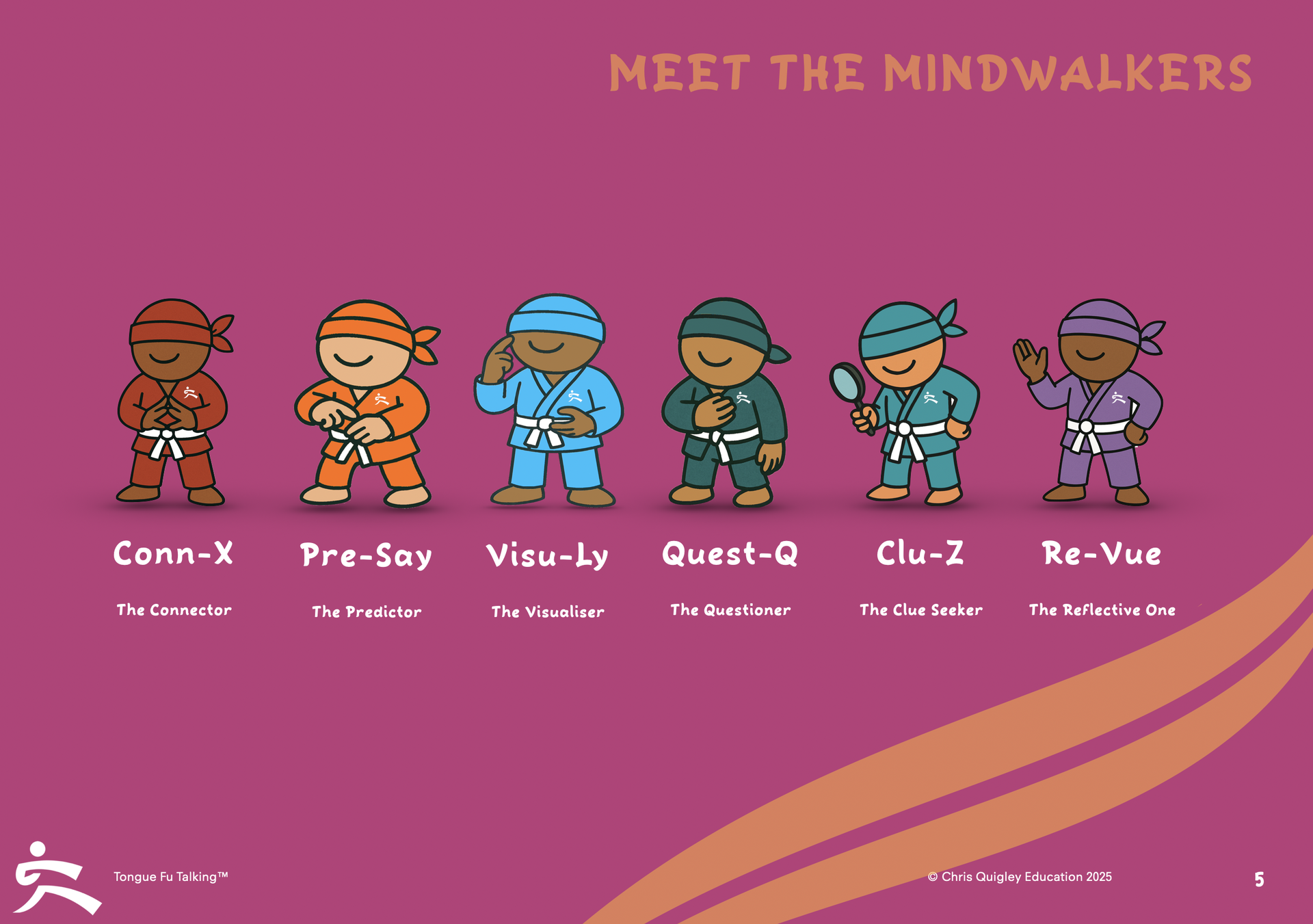
In Tongue Fu Talking®, metacognition is made explicit through six teachable strategies: The Mindwalkers.
These are not vague prompts. They are disciplined ways of thinking that students can learn, practise and apply across subjects.
The Mindwalkers: thinking paths through talk
Each Mindwalker represents a distinct way of engaging with ideas:
- Connections: linking prior knowledge, spotting patterns, relating ideas
- Predictions: anticipating outcomes, using evidence to suggest what might happen next
- Visualising: forming mental images, modelling processes or scenarios
- Questioning: probing, clarifying, challenging assumptions
- Seeking clues: identifying evidence, inferring meaning from what is seen, heard or read
- Reflection: evaluating thinking, considering what has been learned and how
These are not separate from talk. They are enacted through talk.
A student might say:
“I think the temperature will rise because the data shows a steady increase… but I’m not sure if that pattern will continue.”
In that single contribution, they are predicting, seeking clues and reflecting.
This is metacognition in action.
Why this matters: from participation to precision
Without structured thinking, talk can remain superficial. With it, talk becomes a tool for reasoning.
Research suggests that metacognitive strategies have a high impact on learning, particularly when they are explicitly taught and embedded in subject contexts (Education Endowment Foundation, 2021).
But there is a nuance here.
Metacognition is often taught as an internal process. Students are asked to think about their thinking, but this remains hidden.
Oracy changes that.
When students articulate their thinking:
- misconceptions are exposed
- reasoning can be challenged and refined
- ideas can be built collaboratively
In other words, thinking improves because it is shared.
Explorer Mode: where metacognition lives
In Tongue Fu Talking®, this interplay is most visible in Explorer Mode.
This is where students:
- test ideas
- challenge each other
- connect prior knowledge
- refine their thinking
Here, talk is not about getting it right. It is about making thinking visible.
The Mindwalkers give this process structure.
Rather than asking students to “discuss”, we can guide them more precisely:
- Make a connection
- Offer a prediction
- Ask a question
- Seek a clue
- Visualise what is happening
- Reflect on what has changed
This shifts talk from activity to discipline.
From thinking to presenting
Only once ideas are secure does talk move into Presenter Mode.
At this point, students are no longer exploring. They are communicating.
The quality of that communication depends on the quality of the thinking that came before it.
This is why separating oracy from metacognition is problematic. Presentation without exploration leads to surface-level performance. Exploration without structure leads to unfocused talk.
Together, they form a coherent process.
A system, not an add-on
There is a tendency to treat both oracy and metacognition as bolt-ons. A discussion here. A reflection prompt there.
The evidence suggests this is not enough.
Both require:
- explicit teaching
- repeated practice
- clear progression
- integration across subjects
When these elements are in place, students do not just talk more. They think more clearly, reason more effectively and communicate with greater precision.
Final thought
If we want students to become better thinkers, we cannot rely on silent processes alone.
Thinking needs a medium.
Talk provides that medium.
Metacognition gives it direction.
When the two are taught together, students do not just learn what to think.
They learn how to think, and how to express that thinking with clarity and purpose.
Visit Tongue Fu Talking®
References
Alexander, R. (2020) A Dialogic Teaching Companion. York: Dialogos.
Education Endowment Foundation (2021) Metacognition and Self-regulated Learning: Guidance Report. London: EEF.
Mercer, N. and Littleton, K. (2007) Dialogue and the Development of Children’s Thinking: A Sociocultural Approach. London: Routledge.


.png)